Digital IoT Photovoltaic Protocol Converter for smart solar monitoring
Seamless Data Integration Between Photovoltaic Systems and IoT Platforms
Angebot anfordern1 Product Overview
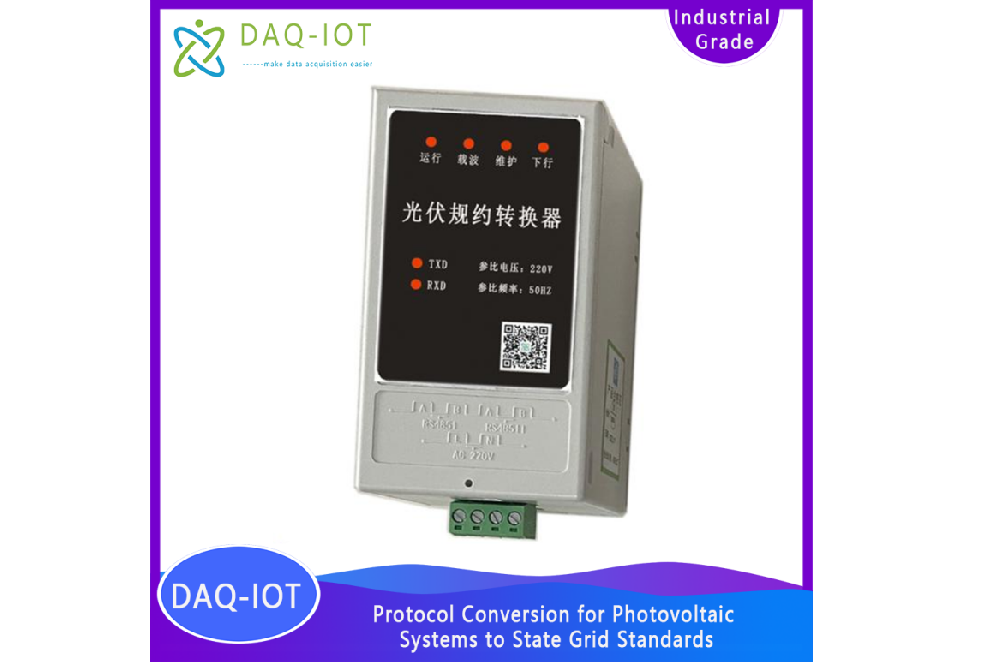
DAQ-GP-485HPLC photovoltaic protocol converter (hereinafter referred to as the converter) is designed by our company to meet the latest needs of the State Grid Corporation in the field of photovoltaic power generation . The photovoltaic protocol converter is a device that collects power generation and power consumption information of photovoltaic inverters. It is used to collect power information of multiple or single photovoltaic inverters and can exchange data with the concentrator.
2 Service Concept
Our company solemnly promises:
You buy not only the product, but also the meticulous and thoughtful technical support service ! ! ! ( =^_^= )
This product only needs ordinary workers to connect the power and install it on site! No debugging is required!
We provide free remote guidance, remote configuration and debugging services, and send data to the user’s designated cloud platform.
Free IoT solution consulting services!
3 Implementation Standards
DL/T698.31-2010 “Electric Energy Information Collection and Management System Part 3-1 Technical Specifications for Electric Energy Information Collection Terminals - General Requirements”
DL/T698.35-2010 “Electric Energy Information Collection and Management System Part 3-5 Technical Specifications for Electric Energy Information Collection Terminals - Special Requirements for Low Voltage Centralized Meter Reading Terminals”
Q/GDW1375.3—2013 “Type Specifications for Electricity User Information Collection Systems Part 3: Type Specifications for Collectors”
Q/GDW1374.2—2013 Technical Specifications for Electricity User Information Collection System Part 2: Technical Specifications for Centralized Meter Reading Terminals
Object-oriented communication protocol for electricity consumption information collection
“State Grid Shandong Electric Power Company Technical Specifications Solidified Distributed Photovoltaic Communication Protocol Converter Communication Interface Adapter”
“Technical Specifications for Interoperability of Low Voltage Power Line Broadband Carrier Communications”
4 Product characteristic parameters
4.1 ** Structural **characteristics
l Installation method: rail type
l Material: PC plastic (shell)
l Size: 108mm62mm70mm
4.2 ** Electrical Characteristics**
l Power supply: AC220V
l Working power consumption: less than 5W
4.3 ** Working environment characteristics**
l Temperature -25 ℃ ~70 ℃ , extreme temperature -40℃~70℃
l Relative humidity: 10%~100% (no condensation)
4.4 Indicator light characteristics
| run | The operating status indicator light is red. If the light flashes alternately for one second and then off for one second, it means the converter is operating normally. If the light is always off, it means there is no power. |
|---|---|
| Carrier | The carrier communication status indicator light is red and green. The flashing red light indicates that the converter carrier channel is receiving data, and the flashing green light indicates that the converter carrier channel is sending data. |
| maintain | Maintenance status indicator light, red and green. Flashing red light indicates that the converter maintenance channel is receiving data, and flashing green light indicates that the converter maintenance channel is sending data. |
| Downside | Downlink communication status indicator light, red and green, flashing red light indicates the converter downstream channel is receiving data, flashing green light indicates the converter downstream channel is sending data. |
4.5 Communication features
l Equipped with 2 RS485 ports, used to connect to the RS485 port of the energy meter or the photovoltaic inverter interface
l With low voltage power line carrier, used to forward the communication commands of the concentrator
l With Bluetooth communication for on-site maintenance
4.6 ****Communication networkingfeatures
The network is formed by carrier or dual-mode . Depending on the carrier or dual-mode technology adopted, two working modes are supported: working with address and working without address.
5 On-site installation
5.1 Installation form
On-site installation diagram
The converter is installed on a guide rail, which is convenient and reliable.
5.2 Port Definition
L: AC 220V power supply L phase input;
N: AC 220V power supply N phase input;
RS485I-A: RS485 first communication line A;
RS485I-B: RS485 first communication line B;
RS485II-A: RS485 second communication line A;
RS485II-B: RS485 second communication line B.
5.3 Installation and wiring precautions
Common problems with power cord wiring:
The converter power cable and power supply have poor contact; the converter power cable should not be connected to 380V power; the power cable must not be connected to the RS-485 signal cable.
Common problems with RS-485 line wiring:
The converter RS-485 line and the meter RS-485 line are connected in reverse; the converter RS-485 line A and line B are short-circuited;
The 485 bus is short-circuited ; the RS-485 line of the interface of some electric meters or photovoltaic inverters is not connected to the 485 bus; the 485 buses under more than two converters are connected together.
6 Name and content of harmful substances in the product
FAQ – Digital IoT Photovoltaic Protocol Converter
1. What does this converter do?
It converts photovoltaic system data into IoT-compatible protocols for monitoring and cloud integration.
2. Which PV systems is it compatible with?
It supports most mainstream solar inverters and controllers using standard industrial protocols.
3. Can it support multiple devices?
Yes, it can collect and process data from multiple PV inverters simultaneously.
4. Does it support real-time monitoring?
Yes, it enables real-time data transmission for solar performance tracking.
5. Is it suitable for large solar farms?
Yes, it is scalable and suitable for both small and large photovoltaic installations.
6. Can it connect to SCADA systems?
Yes, it supports SCADA, EMS, and other industrial monitoring platforms.