IIOT Battery-Powered Infrared Temperature Measurement
🌡️ IIoT Battery-Powered Infrared Temperature Measurement Sensor – Key Advantages
Angebot anfordern1 Product Introduction
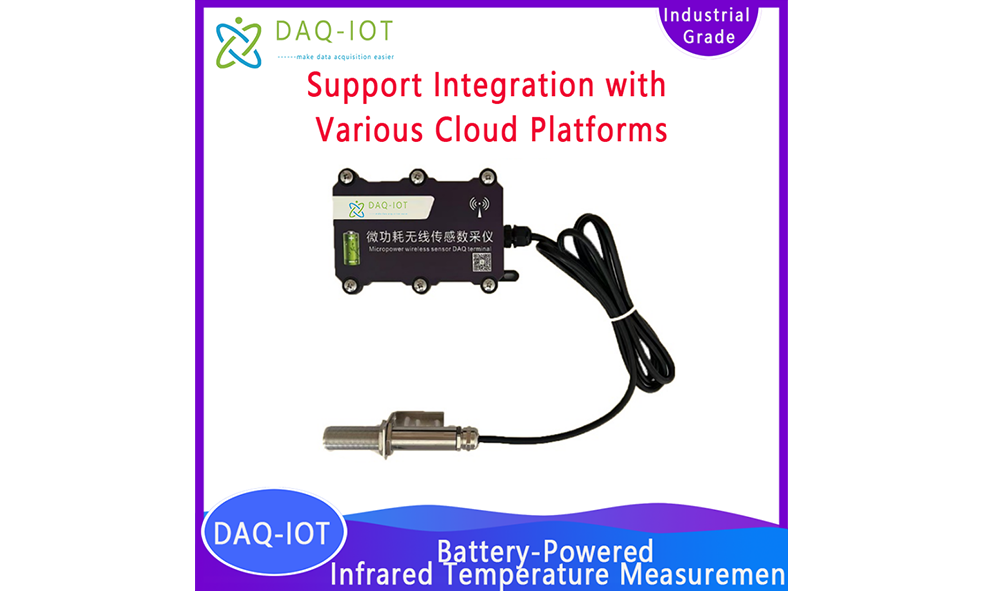
DAQ - LP - IRT LoRaWAN low-power wireless infrared temperature sensor is a wireless infrared temperature measurement product for the industrial field launched by Shanghai Shucai IoT Technology Co., Ltd. This product can calculate the surface temperature of an object by receiving the infrared radiation intensity emitted by the target without contacting the target , and report the data regularly through LoRaWAN and other methods. Non-contact acquisition is the biggest advantage of infrared temperature measurement, allowing users to easily measure targets that are difficult to approach or move. As a new generation of temperature measurement data cloud product, it can widely adapt to various industrial scene requirements.
The sensor terminal supports LoRaWAN/LoRa/WiFi communication , overcoming the wireless communication obstruction caused by the special environment on site, greatly simplifying the on-site deployment time and reducing construction costs . This terminal supports 12V voltage input , reverse connection protection , high measurement accuracy, and easy installation.
| model | Features |
|---|---|
| DAQ -LP- IRT LoRaDAQ -LP- IRT LoRaWAN | loRa / LoRaWAN communication, long-life lithium battery power supply, suitable for occasions with low acquisition frequency and difficult external power supply. |
| DAQ -GP- IRT LoRaWAN | LoRaWAN communication, 220V AC/12V DC power supply, suitable for occasions with high acquisition frequency or convenient external power supply. Because the device is online by default, it can support remote configuration parameter debugging, and only needs to be installed and connected to the power supply on site. |
2 Service Concept
****Our company solemnly promises:
You buy not only the product, but also the meticulous and thoughtful technical support service ! ! ! ( =^_^= )
This product only needs ordinary workers to connect the power and install it on site! No debugging is required!
We provide free remote guidance, remote configuration and debugging services, and send data to the user’s designated cloud platform.
Free IoT solution consulting services!
3 Product Features
3.1 Infraredtemperatureacquisition characteristics
Collection type: non-contact temperature measurement
Measuring range: default 0-500°C ( higher temperature range can be customized )
Distance factor: 20:1
Measurement error: ±1.5% of measured value or ±2.5°C whichever is greater
Collection frequency: once every 12 hours by default, supports remote configuration
3.2 PT100temperatureacquisition characteristics
Acquisition type: pt100 temperature probe temperature measurement
Measuring range: Default -200 ~800 °C ( higher temperature range can be customized with K-type thermocouple probe )
Measurement error: ± 0.5 °
Collection frequency: once every 12 hours by default, supports remote configuration
3.3 Electrical Characteristics
Power supply: Long-life lithium battery (DC power supply optional)
Standby current: 4.17u A
Standby power: 15.029u W
3.4 Communication****characteristics
Wireless transmission method: LoRaWAN/LoRa/WiFi
Communication protocol: MQTT/TCP/UDP/HTTP/SSL/ModBus RTU, other protocols can be customized
Data forwarding: any public network server
Number of server centers: Supports reporting data to up to 7 cloud servers at the same time.
Heartbeat packet: supports custom heartbeat packets, which can be set to signal strength.
Registration package: supports custom registration package, which can be set to IMEI code.
Positioning: Support LBS base station positioning, convenient for querying device location.
3.5 Structural characteristics
Antenna type: built-in antenna (external antenna optional)
Material: PC/ABS/PMMA (housing)
Main protection level: IP65
Dimensions: 122 mm x 92 mm x 42 mm (length x width x height)
Distance measuring probe structure: non-contact
Main installation method: wall hanging or screw fastening
Probe installation method: Paste or screw fastening, cable tie binding installation
4 Data reporting communication protocol
4.1 Protocol analysis instructions
There are multiple push methods such as UDP/TCP/MQTT/HTTP. To receive data, users need to provide the public IP (or domain name) address and port number of the cloud server.
Example of a data message in JSON format:
{” temp ”: 56 . 7 2, “ID”: “860344048491162”}
Message analysis:
{
“temp” : 16.72 , //distance, in meters
“ID” : “860344048491162” //Device ID
}
4.2 Protocol customization
If you need to customize other communication protocols, please contact our sales staff.
5 Platform docking
5.1 Default Platform
The product is connected to our designated industrial Internet of Things platform by default when it leaves the factory. The platform interface is as follows:
Computer browser interface
WeChat access interface on mobile phone
6.1 User-specified platform
Taking the Alibaba Cloud platform docking as an example, after the user creates a product and adds a device on the Alibaba Cloud IoT platform, the user needs to provide a triple: {ProductKey, DeviceName, DeviceSecret} and the MQTT topic to be published.
For example, the values of the triples are:
ProductKey = b0FMK1Ga5cp
DeviceName = 862991419835241
DeviceSecret = y7MTCG6Gk33Ux26bbWSpANl4OaI0bg5Q
❓ IIoT Battery-Powered Infrared Temperature Measurement Sensor – FAQ
(For Power Utilities / Factory / EPC / Industrial Projects)
1. What is this infrared temperature sensor used for in industrial applications?
It is used for non-contact temperature monitoring of electrical and mechanical equipment , helping detect overheating risks in real time for safety and maintenance.
2. Can it be used for high-voltage equipment in power systems?
Yes. It is widely used in power utilities, substations, and electrical cabinets for safe non-contact temperature monitoring of high-voltage components.
3. Does the sensor require wiring or external power supply?
No. It is battery-powered and fully wireless , making it ideal for remote, hard-to-access, or large-scale industrial deployments.
4. What communication methods does the sensor support?
It supports NB-IoT, LoRa, 4G, and WiFi (optional) , ensuring flexible integration with IoT platforms, SCADA systems, and cloud monitoring systems.
5. Can it integrate with SCADA or EPC monitoring systems?
Yes. The sensor can easily integrate into SCADA, EMS, and EPC project platforms for centralized temperature monitoring and data analysis.
6. Is it suitable for harsh industrial environments?
Yes. It is designed for high temperature, dust, vibration, and outdoor environments , commonly found in factories, substations, and oil & gas facilities.
7. How does it help with predictive maintenance?
By continuously monitoring temperature trends, it can detect abnormal heating early , helping prevent equipment failure and reducing downtime.
8. What is the battery life of the sensor?
Depending on the reporting interval, the battery can last 1–5 years , making it ideal for long-term unattended monitoring.
9. Can it monitor multiple devices in a factory or EPC project?
Yes. It supports large-scale deployment, making it suitable for multi-point temperature monitoring across factories, plants, and infrastructure projects.
10. What industries typically use this infrared temperature sensor?
It is widely used in power transmission systems, manufacturing plants, steel industry, oil & gas, EPC engineering projects, and smart factories.
💰 Inquiry & Purchase
-
📩 Get a Free Quote Now
-
⚡ Request Project Pricing
-
🧾 Get Bulk Order Offer
-
💬 Ask for Best Price Today