RS485 & Lora Vibriation Sensor
1 Product Overview
RS485 vibration sensor:
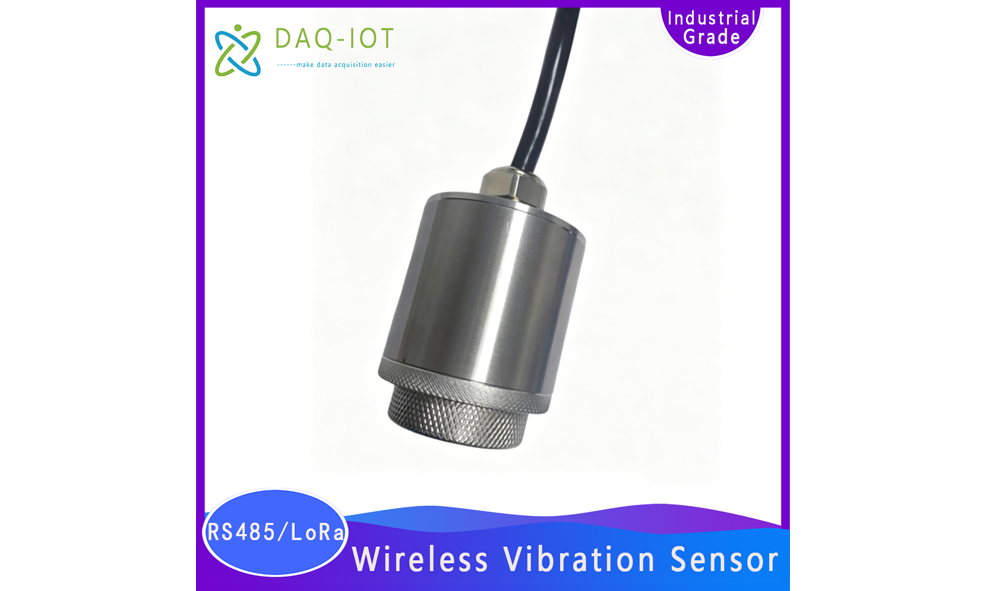
The DAQ-GP-VT485 vibration speed (acceleration) sensor features a stainless steel housing design. Internally, it primarily consists of a power supply module, a vibration acquisition unit, and a data processing and transmission module. The sensor collects and processes vibration values from the device, which are then transmitted to the receiving terminal via 485 communication for centralized monitoring.
LoRa wireless vibration sensor:
The DAQ-LP-VTLORA wireless vibration velocity (acceleration) sensor features a stainless steel housing design. Internally, it primarily consists of a battery, a vibration acquisition unit, and a data processing and transmission module. The vibration values collected and processed by the sensor are transmitted to a wireless receiving terminal via LoRa wireless communication for centralized monitoring. Each sensor possesses a unique communication ID number.
It can be applied to online measurement of vibration speed, acceleration, and temperature of motor equipment, reducers, fans, generators, air compressors, centrifuges, water pumps, and other equipment in various fields such as coal mining, chemical industry, metallurgy, electric power, building materials, automobiles, and machinery manufacturing.
2 Service Philosophy
Our company solemnly promises:
What you have purchased is not just a product, but also meticulous and thoughtful technical support services!!! ( =^_^= )
This product only requires ordinary workers to connect the power and install it on site! No debugging is needed!
We provide free remote guidance and remote configuration and debugging services, and send the data to the cloud platform specified by the user.
Free IoT solution consulting services!
3 Product Features
3.1 RS485Vibration sensor characteristics
Dedicated MEMS chip technology, precise integration calculation;
The power supply is stable, eliminating the need for frequent maintenance of the power source and ensuring an exceptionally long working life;
The data transmission is efficient with low latency and strong anti-interference capability.
Adopting RS485 communication and Modbus communication protocol
3.2 RS485Structural characteristics of vibration sensor
Power supply mode: DC12~24V external power supply
Standby current: ≤5mA
Detection cycle: 800ms
Measurement range: Acceleration: 010g; Speed: 060mm/s; Amplitude: 050000um; Frequency (effective value): 02000Hz
Ambient temperature: -40~85℃ (relative humidity: ≤90%)
Protection level: IP67
Measurement method: vertical or horizontal
Installation method: magnetic attraction or screw hole M10×1.5×10 (deep)
3.3 LoRa Characteristics of wireless vibration sensors
Dedicated MEMS chip technology, precise integration calculation;
9000mAh lithium-ion battery, replaceable, with an ultra-long working life;
433M free frequency band, external antenna, ultra-long transmission distance.
3.4 LoRa Structural characteristics of wireless vibration sensors
Power supply: Lithium-ion battery 9000mAh (default, optional 19000mAh or DC12~24V external power supply)
Standby current: ≤3uA
Detection cycle: default 30s, adjustable from 1 to 60s
Measurement range: 50mm/s (effective value)
Sensitivity: 0.05mm/s ±5% (measured at 80Hz and 20℃)
Ambient temperature: -40 to 85℃ (relative humidity: ≤90%)
Protection level: IP67
Measurement method: vertical or horizontal
Installation method: magnetic attraction or screw hole M10×1.5×10 (deep)
Transmission distance: ≥300 meters (up to 500 meters or more with an external suction cup antenna, depending on the site)
Transmission mode: Wireless communication via LoRa at 433MHz
4 communication routine
4.1 register address
Modbus Protocol 03 function code
| register address | PLC or configuration address | content | operation | byte length |
|---|---|---|---|---|
| 00 01 | 40001 | Xpeak acceleration | read-only | 2 |
| 00 02 | 40002 | Ypeak acceleration | read-only | 2 |
| 00 03 | 40003 | Zpeak acceleration | read-only | 2 |
| 00 04 | 40004 | Xspeed effective value | read-only | 2 |
| 00 05 | 40005 | Yspeed effective value | read-only | 2 |
| 00 06 | 40006 | Zspeed effective value | read-only | 2 |
| 00 07 | 40007 | temperature | read-only | 2 |
| 00 08 | 40008 | ZEquivalent Shaft FrequencyHz | read-only | 2 |
| 00 09 | 40009 | Xdisplacement | read-only | 2 |
| 00 0A | 40010 | Ydisplacement | read-only | 2 |
| 00 0B | 40011 | Zdisplacement | read-only | 2 |
4.2 Description of the value in the baud rate register (0x0D):
| register address | register value | Attribute (Baud rate) |
|---|---|---|
| 0x0D | 00 06 | 600 |
| 00 0C | 1200 | |
| 00 18 | 2400 | |
| 00 30 | 4800 | |
| 00 60 | 9600 | |
| 00 C0 | 19200 |
Note: The setting value is the actual baud rate ÷ 100.
4.3 Protocol Customization
If you need to customize other communication protocols, please contact our business personnel for communication.
❓ RS485 & LoRa Vibration Sensor – FAQ
1. What is this vibration sensor used for?
It is used to monitor vibration speed and acceleration in industrial equipment, helping detect mechanical faults and prevent unexpected downtime.
2. What communication protocols does the sensor support?
It supports RS485 for wired industrial networks and LoRa for long-range wireless monitoring , offering flexible deployment options.
3. Can the sensor provide real-time monitoring?
Yes. The sensor transmits vibration data in real time to a receiving terminal or IoT platform for centralized monitoring and analysis.
4. What environments is the sensor suitable for?
The stainless steel housing and industrial-grade components make it suitable for factories, production lines, machinery, and harsh industrial environments.
5. How accurate is the vibration measurement?
The sensor provides high-precision vibration speed and acceleration measurements , enabling reliable condition monitoring and predictive maintenance.
6. Can it integrate with existing industrial systems?
Yes. It is compatible with PLCs, SCADA systems, and IoT monitoring platforms , making integration into existing industrial networks seamless.
7. Does it support both wired and wireless deployment?
Yes. RS485 supports wired industrial network connections, while LoRa enables long-range wireless monitoring , suitable for remote or hard-to-reach equipment.
8. Can the sensor help reduce maintenance costs?
Absolutely. By providing early vibration alerts and real-time monitoring , it allows predictive maintenance, reduces unexpected downtime, and lowers maintenance costs.