Factory Production Number/Model/Actual-Target Output Electronic Kanban with Infrared Sensor Display
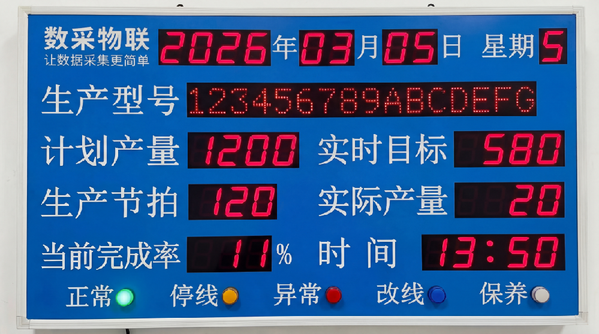
Product Details
1 Product Overview
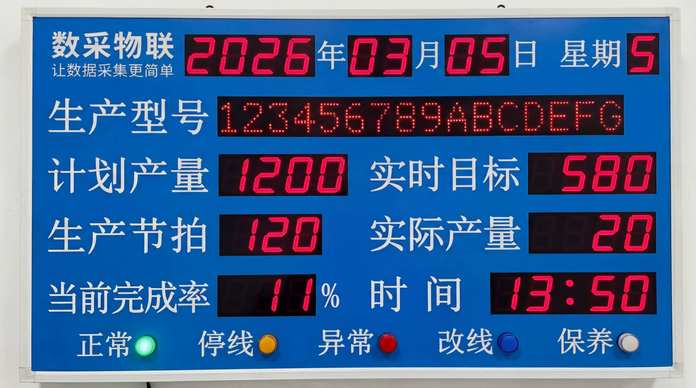
LED production board
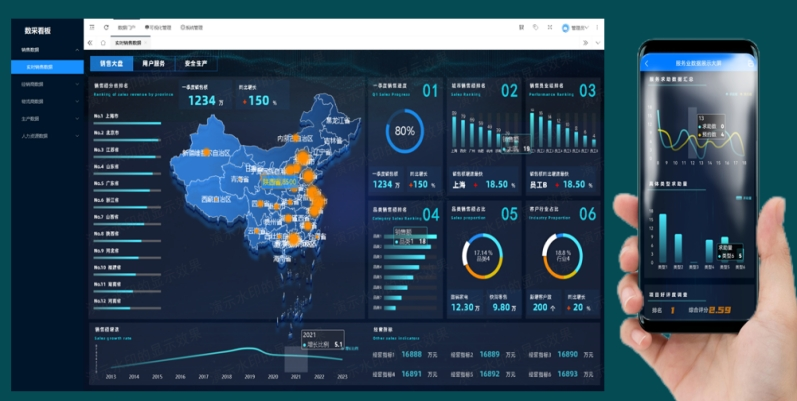
Control-room large-screen board
This electronic display board, model DAQ-GP-Dashboard, is designed by Shanghai Daq-IoT Technology for real-time visual management of workshop production lines. It uses a high-brightness LED dot-matrix display and works with infrared sensors to automatically collect actual output. It supports production-model entry, planned/real-time target output setting, production takt monitoring and automatic completion-rate calculation, and retains data after power loss. It suits production lines and single-machine capacity monitoring in all kinds of manufacturing workshops.
2 Ordering Specifications and Selection
Custom manufacturing service — Daq-IoT provides one-to-one dedicated customization to support efficient production and easy management. Customization includes:
(1) Dedicated solution design: board content tailored to the user’s production scenario (2) Multiple sizes: choose the size that matches the installation requirement (3) Multiple data-collection methods: adapt to different factories’ acquisition needs (4) Complete accessories: optional accessories selected as required
Configurable Field Names (Reference)
| Field | Field | Field |
|---|---|---|
| Line / production line name | Actual output | Production takt |
| Achievement rate | Date and time | Standard efficiency |
| Cumulative completion | Standard hourly output | Downtime |
| Output per capita | Notification bar | Team leader (manager) |
| Output value per capita | Defect quantity | Expected attendance |
| Defect rate | Equipment number | Actual efficiency |
| Production date | Actual hourly output | Units started |
| Remarks | Target output | Timely output |
| Actual attendance | Utilization rate | First-pass yield |
| Monthly plan | Faulty station | Running time |
| Order number | Product model | Remaining output |
Display can also be defined by the user.
4 Product Characteristics
4.1 Electrical Characteristics
- Operating voltage: AC220V +-10%, 50Hz
- Overall power consumption: <= 50W
- Standby power consumption: <= 5W
- Fuse rating: 5A/250V
4.2 Communication Characteristics
- Communication interfaces: RS485/RS232/Ethernet (optional)
- Communication protocol: Modbus-RTU/TCP (default); user-defined protocols supported
- Transmission rate: 9600bps-115200bps (RS485), 10/100Mbps (Ethernet)
- Communication distance: RS485 <= 1200 m, Ethernet <= 100 m
4.3 Structural Characteristics
- Display material: LED dot-matrix screen, readable in strong outdoor light
- External dimensions: customized (standard 600 x 400 x 50 mm / 800 x 500 x 70 mm)
- Mounting: wall-mounted
- Protection rating: IP54 (indoor)
4.4 Operating Environment
- Operating temperature: -10 degC to 40 degC
- Storage temperature: -20 degC to 60 degC
- Relative humidity: <= 85% RH (non-condensing)
- Altitude: <= 2000 m
5 Core Advantages
- Accurate counting: infrared sensor response <= 200 ms, counting error <= 0.1%, with anti-jitter filtering.
- Flexible configuration: production model, target output, takt and other parameters can be changed quickly with a remote control, suiting high-mix low-volume production.
- Data interoperability: integrates with MES, ERP and similar systems for automatic upload and analysis of production data.
- High reliability: industrial-grade components with an MTBF of >= 50,000 hours.
- Easy maintenance: modular design for fast fault location; parts can be replaced without special tools.
- Core function: improves production efficiency and optimizes the management system, helping factories achieve visualized production-data management. Custom manufacturing, simple operation and a five-year warranty are provided.
6 Data Reporting Communication Protocol
6.1 Protocol Parsing
- Protocol type: Modbus-RTU/TCP (default); user-defined protocols supported
- Data-frame structure: address code + function code + data field + check code
- Reported data: production model, planned output, real-time target, actual output, completion rate, line status, etc.
- Reporting period: 1s-60s (configurable)
6.2 Protocol Reception Test
- Test tools: Modbus Poll / serial debugging assistant
- Test steps: (1) Configure communication parameters (baud rate, data bits, parity). (2) Send a read command and verify the data-frame format and content. (3) Simulate changes in line status and check that the reported data updates accordingly.
6.3 Protocol Customization
- Protocol fields, data format and reporting logic can be customized to the user’s platform requirements.
- Customization lead time: about 7-15 working days, with protocol documentation and test tools provided.
7 Platform Integration
7.1 Default Platform
- Platform: the company’s own production management platform (ProMan)
- Connection: Ethernet / RS485
- Functions: real-time data display, historical queries, report generation, abnormal-condition alarms
7.2 User-Specified Platform
- Supports integration with mainstream industrial software such as MES, ERP and SCADA.
- Process: requirement confirmation -> protocol development -> joint debugging and testing -> go-live acceptance.
- Deliverables: integration documentation, SDK, test report.
8 Precautions
- Installation, wiring and repair must be carried out by a professional electrician; never work with the power on.
- Do not expose the device to rain, water immersion or direct sunlight; keep it away from heat and ignition sources.
- Avoid squeezing, pulling or scratching the sensor cable.
- Clean the screen and sensor probe regularly; do not use corrosive solvents.
- Cut off the power during long shutdowns and protect against moisture and dust.
- Do not disassemble or modify the device yourself, otherwise the warranty is void.
- If smoke, odor or abnormal noise occurs, cut off the power immediately and contact our after-sales service.